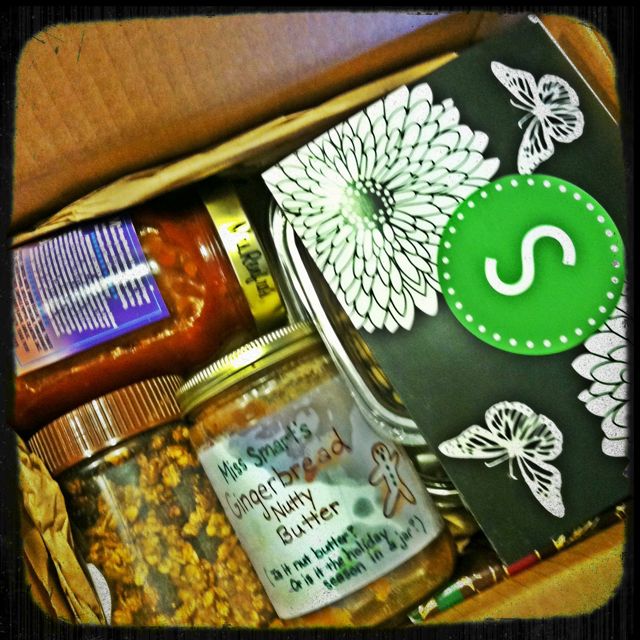
Earlier this month you may have read my post about becoming a foodie penpal. Well today is the day that all the foodie penpals share about their boxes. My box came from a lovely woman named Emily from Midland, Texas and within it was all kinds of Texas delicacies like Texas Trash (a sweet concoction kind of like puppy chow) and Amazing Corn (kind of popcorn but kind of not). I was especially excited for the Hatch Green Chiles in the box because they were perfect for a Mexican-inspired dish that I learned from my Aunt Ethel. Aunt Ethel was my dad’s oldest sister and since she didn’t have any kids of her own, she loved to spoil her nephews and nieces with her amazing cooking. She made the best fried chicken, red velvet cake, and ranger cookies that I’ve ever had. Another one of her great recipes were her enchiladas. With my Hatch Green Chiles, I had everything I needed to make them for dinner last night.
Aunt Ethel’s Chicken Enchiladas (yields 4)
2 large chicken breast cooled and cubed or shredded
1 cans of cream of chicken soup
1/4 cup milk
8 oz. sour cream
4 oz. diced green chilies
1/2 bunch of green onions, chopped
1 pkg. large flour tortillas (I substitute whole wheat tortillas instead)
1.5 cups of shredded cheddar cheese
Directions
Spray 10 x 15 glass baking dish
Mix soup, milk, sour cream, chilies and green onions. Spread one cup of mixture on bottom of baking dish. Reserve 1 ½ cups for top.
Add chopped chicken to remaining mixture. Spread a roll of filling across the center of the tortilla. Roll and place, seam down, in pan. Cover with remaining sauce and cheese on top.
I love Peace Corps Volunteer blogs. 1. They are always in interesting locations. 2. They always have great interactions with local people. 3. I can live vicariously through them. I started following كوين ف المغرب (Quinn in Morocco) almost four months ago for all of these reasons. The blogger, Sarah, is an Atlanta native who studied art at the University of Georgia (Go Dawgs!) and now finds herself teaching English to the local children in Tamslouht, Morocco. Having finished her first year as a PCV this coming November 17, Sarah’s blog is full of great insight into the Moroccan way of life. Her blog highlights everything from Ramadan to Moroccan weddings to current political and religious issues in the country. I was excited to “meet up” with Sarah via email to learn all about the PCV experience.
What is a typical day for you as a PCV in Morocco?
A typical day…oh, what a faraway dream from another land!
I have found that there is absolutely no such thing as a typical day in Morocco. Even my best-laid plans are always disrupted by invitations to tea at a complete stranger’s house, last-minute excursions to the city, meetings that I had no idea were happening, students not showing up to my classes (or showing up at my front door in droves when I had no idea a class would be meeting), donkey traffic jams preventing me from getting anywhere on time…the possibilities are endless. Additionally, life in Morocco is really seasonal. By this, I mean that my “typical” Tuesday during the school year is very different than a Tuesday during the summer. And a Tuesday during Ramadan is a completely different animal entirely!
If I had to draw up a “this is what I spend most of my time doing” schedule, patched together from the most common occurrences of my life during any given time, it would probably go something like this:
In the morning, I wake up around 6am to the alarm that I optimistically set the night before— you know, to go running and do that whole “healthy lifestyle” thing. I rarely make it out of bed. I sleep in until my next alarm around 8 or so and then spend a bit of time checking emails, reassuring people I’m alive, etc. My mornings revolve around last-minute lesson-planning for my English classes at the local youth center, teaching those classes, or spending time at the local café studying Darija with my tutor. Lunch usually occurs in the 12-3pm timeframe, and this can be anything from a depressing concoction from my own fridge (Lentils? Third day in a row? Why not!) to a delicious meal at a friend’s house. I always cross my fingers for an invitation. The afternoon involves more last-minute lesson planning, classes, meetings with associations, and possibly activities at the youth center. In the evening, I go home, to a friend’s house, or to my host family’s house. The latter two options involve sitting around, watching Turkish soap operas dubbed in Darija, and eating more delicious food. Bedtime comes pretty soon thereafter.
You’ve got great packing list! Of all you have, what three things could you absolutely not live without?
A quick aside about my packing list— that was composed after coming to Morocco and seeing what I actually needed (as opposed to what I brought with me). Let me assure you, those things were completely unrelated.
Nevertheless, the three things that I absolutely can’t live without are:
My small book: This was a going-away gift from the museum I used to work for. It’s pocket –sized and perfect for writing down new words that I learn in the various places I end up during any given day.
My computer: It’s not particularly fancy, but it has enabled me to communicate with the outside world during the past year. Even without an internet connection, ending the day with an episode of the West Wing in the comfort of my bed (as opposed to the local cyber café) is a wonderful, purely American comfort food.
My glasses: Not only are they practical, as I really can’t see anything without them, but they’re always a good conversation starter with little kids (“Can I wear your glasses?” “Wow, look how goofy I am!”). In big cities, they also diffuse a lot of unwanted attention. It’s like I’m a mystical creature with large black glasses instead of a foreign woman to hassle.
What is your favorite thing to do with visitors when they come to Tamslouht?
I have taken every visitor to the local café that sits right in the heart of Tamslouht. It’s a really cute, very Moroccan establishment that I visit every day, if not multiple times a day. A cup of coffee or a soda is less than a dollar, the owners (Marwan and Mustapha) know and love me very much. From their plastic chairs, I can literally see everyone in the town walk by if I sit there long enough. It has that “rustic charm” that only stray cats napping on the chair beside you and soda delivered in glass bottles can offer. For American visitors, it’s also extremely entertaining for them just sit and observe the rhythm of Moroccan life for a bit. The donkeys pulling carts of vegetables and small children are always a hit.
How do you use art to work with your students?
I spend the majority of my time teaching English. However, because of my personal background (I studied art and art history in college) and my desire to make learning fun, I really try to implement as many creative activities into my curriculum as possible.
Mostly, I use art as an English-teaching method. For example, if we’re studying adjectives, I’ll make students randomly pick an adjective and a noun and draw a picture combining the two. This ends up being not only fun and an effective way to learn (how can you not remember something like “fat table” or “sad tajine”), but I also end up getting free classroom decorations. The kids really dig it.
What have your students taught you?
More than I’ve taught them. I swear.
For new PCVs, what advice would you give them to have a successful start?
Just laugh it off. Peace Corps usually ends up being an amazing, life-changing experience….that is simultaneously a complete emotional rollercoaster. We volunteers joke with each other a lot about the way that the tiniest, slightly-negative experience can send the most even-tempered volunteer to tears. Also, living in another culture, you have a lot of things said to you that are completely normal, if not even complimentary in this culture— while being simultaneously offensive to you as an American.
The best example I give people is the frequency with which people call me fat. It’s a huge (ha ha ha) compliment here, although not so much to an American. Just a week or so ago, I was at my sitemate’s host family’s house for dinner. We had walked over in the pouring rain and they insisted that we change our clothes as not to get sick from the cold. My skinny sitemate had no problem slipping into his host brother’s sweat pants; I, meanwhile, literally could not button the “largest pants they owned.” Direct quote. This is a family of very small-boned, genetically-blessed women, and they were very entertained by the fact that I couldn’t fit into the largest pair of pants that they owned (probably the equivalent of a size 6 in America). They kept telling me that my stomach was huge! I was so fat! Ha ha ha! This is the kind of situation where you have two choices: break down and cry because it’s the 6th time today where someone has called you fat and you’re beginning to believe it, or just laugh and take it in stride. Seriously, if you look at everything the right way, you’ll see that it’s all complete sitcom material— even the stuff that can really hurt and make you want to pack your bags. Taking things lightly will not only make your Peace Corps experience exponentially easier, but it will make all of the potential for cross-cultural misunderstandings null and void.
With new friends from Iraq and Bangladesh, the Hajj and Eid al-Adha were topics of discussion this past week. As a Christian, I will never be allowed to experience Mecca during the Hajj (it’s a Muslim-only event) but I decided to at least do some research and learn a little more about the biggest religious gathering on earth. (This year it was estimated that 4 million pilgrims attended the Hajj; 1.7 million were from abroad.)
After some perusing on You Tube, I found this great 14 minute documentary by Suroosh Alvi, a Muslim from New York City. He snuck a handicam into Mecca on his own personal Hajj last year and shared his own thoughts on the experience but also the process and rituals that were required to complete the Hajj. It really helped me understand a little more and I would really recommend viewing it if you’re curious about the Hajj.
The Hajj is one of the five pillars of Islam and requires each Muslim who is physically and financially able to make a pilgrimage to Mecca. Of the pictures I’ve seen of the Hajj before, the one that comes to mind is of the Kaaba, the black box that the Muslim believes to be the house of God. As part of the Hajj, the pilgrims must perform Tawaf where they circle the Kaaba seven times and then kiss the black stone (or point to the stone if the crowds are too bad).
The next ritual of Hajj is to go to Mt. Arafat, where the prophet Muhammad gave his last sermon, and pray. Mt. Arafat is also known as the Hill of Forgiveness and is a highlight of the Hajj as the Muslim pilgrim spends the afternoon in contemplation and prayer.
The ritual of stoning Jamrat Al-Aqabah follows the day at Mt. Arafat. Jamrat Al-Aqabah can be found in Mina and consist of three columns (recently replaced by three walls) that represent the Devil. For the ritual, the pilgrims must throw 21 stones at the columns symbolizing their defiance of the Devil.
Once the stoning is complete, the pilgrims must slaughter their sacrifice in celebration of the sacrifice that God provided Abraham in replacement for his son (for Christians and Jews, this story may be familiar). This holiday is celebrated by all Muslims whether in Mecca or not and is called Eid al-Adha.
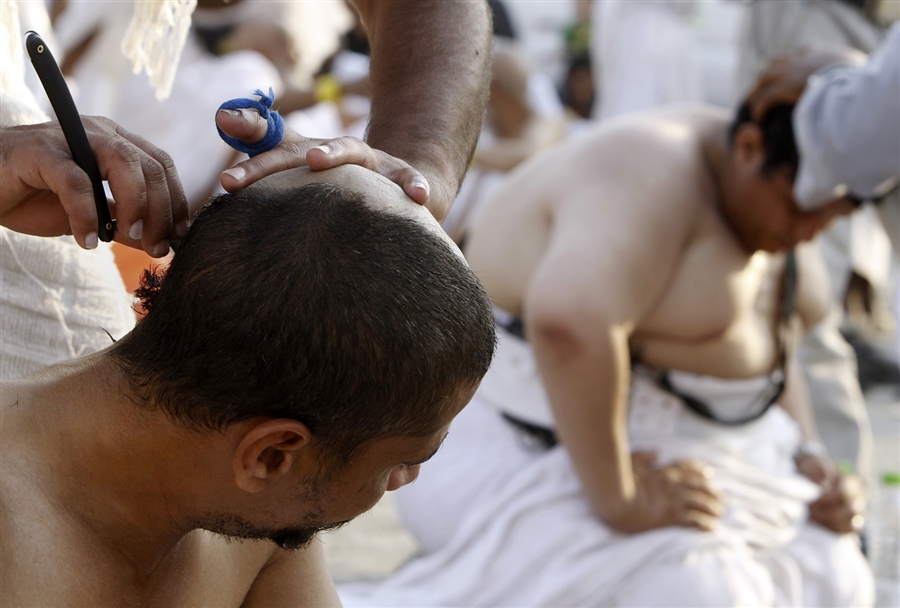
After stoning the Devil and slaughtering the sacrifice, the final rite of that day is shaving the head (for men) or trimming the hair (for women). The hair cut symbolizes an important stage of the Hajj and almost all restrictions are lifted from the pilgrim after this point.
When these rituals have been completed, the pilgrim returns to the beginning and once again prays and circles the Kaaba seven times. These rites are completed by both men and women of the Muslim faith, although the rules are slightly different for the sexes. For example, women cannot complete the Hajj while menstruating, nor can they attend Hajj without a male relative to escort them. But once the Hajj is complete, whether male or female, they are given the honored name of Hajji.
I will admit that this account is far from detailed, and despite reading multiple websites and watching several videos, the Hajj is still a bit of a mystery to me. But considering even devout Muslims need a guide to help them through the Hajj, I decided not to feel to bad. However, I am still curious to learn more and welcome any comments from my more experienced readers!
I recently have started helping a young man from Iraq with algebra. Thankfully I’ve been studying for the GRE and I’m not too rusty. But after two and half hours and only 30 math problems into the 50 problem homework, I felt disenfranchised with American education and walked away heartbroken for this young man.
This 15-year-old boy came to the US having been out of school for over 5 years due to the war in Iraq. Knowing no English, he was still placed in a public high school only to fail his first year. Now having been here for a few years, his English is pretty incredible and his accent is almost non-existent. But when it comes to knowing words like denominator, quotient, or divisible, those are not in his repertoire. As one of many students in his class, the likelihood of getting individual help is pretty slim for him, and the chance that he’ll ever catch up on the five years of education he missed is grim at best.
I’m far from saying that I know the best solution for this boy, but I feel he is being done an injustice. I am ever so grateful that my country has become a safe harbor for him and his family. But while he is protected from the bombings and shells, the effects from the war are still ever-present in his life as struggles to do 9th grade math with a 4th grade education.
Say a prayer for me, dear friends, that I will remember the rules for graphing a line, solving for x, and completing the quadratic equation. And most of all that I will have the ability to explain them in a way he can understand.
Well, dear readers, I need your help. After more than 20 great Abroad Blogs of the Week, I want your recommendations and nominations. Who should I be reading? Who is doing great stuff abroad? Who have you added to your reader recently? If you write a great abroad blog or know of someone who does, read through the directions below and nominate your favorite abroad blogger via my new form. I can’t wait to get some new reading recommendations!
Criteria to be an Abroad Blog of the Week:
The blogger must either be about to go abroad, currently abroad, or recently returned from abroad
The blog must predominately be about culture/travel
Posts should be fairly regular (at least once or twice a week).
Requirements to be an Abroad Blog of the Week:
Let me ask you 4-6 questions via email
Send back your responses by the following Monday
If you want (i.e. this is not a requirement), welcome any new readers from Global from Home the day I post our interview.
Easy, peasy.
If you would like your blog to be an Abroad Blog of the Week or know of another blog you think I should scope out, let me know! You can anonymously submit your nominations at the Abroad Blog of the Week Nomination Form.
Everyday I drive by this cute little florist shop called A Date with Iris. Their store window is creatively decorated for Halloween with skulls and spider webs and has an atmosphere which draws you in. At least it drew me in a few weeks ago. The owners are lovely and welcoming and the shop is full of gorgeous flowers and unique gifts. It is also now my go-to for Oklahoma postcards for my Postcrossing correspondence.
But not only is A Date with Iris overflowing in local hospitality, but currently they are serving as hostesses with the mostest to an international guest. As part of an entrepreneurial exchange through the University of Oklahoma, A Date with Iris is hosting a florist shop owner from Taka, Bangladesh named Tanya. Upon finding out about their exchange, they graciously invited me to meet her. So yesterday I sat in the back of their florist shop and we talked culture, food, politics, and education.
One of the most fascinating parts of our conversation was to hear Tanya’s views on wealth and her questions on why Americans send their jobs to Bangladesh and China. She expressed her great frustration on how America places stipulations on regulations on other countries while not paying any more for the goods or being knowledgable of the economic and social structures of the countries it is dealing with. One of the most challenging aspects of our conversation was about child labor. Tanya’s explained that many factories in Bangladesh have large signs across them that say, “We do not use child labor.” However, she explained, if a child doesn’t work, it does not mean he is in school or will be taken care of by the government like here in the U.S. Instead the child will be on the street begging and hoping someone will feed him. She asked me the question, “So is it better for the child to work or for the child to starve?”
Sitting a florist shop in the middle of a neighborhood in Oklahoma City, I had a conversation that I doubt I will ever forget. I learned so much in that 90 minutes and found culture in an unexpected place.
I’ll never forget standing in the Metro in Paris and being horribly embarrassed by the college kids who were a few cars down. They could be heard by every passenger as they swore and rough housed with each other. With their college t-shirts, flip-flops, and southern accents, there was no denying they were Americans. It made my friend and I start speaking in Italian just so we wouldn’t be associated with their bad manners. That experience has made me stress to my own students just how important it is to be aware of how we as a culture and people are viewed by others.
I came upon the Listening Project trailer just this week and it was reminiscent of my Metro experience. As I engage in the American Presidential Debate on foreign policy, this film has reminded me that we are not a nation that functions in a bubble, but one who is dependent and depended on by the world.
A few weeks ago I found out about a great program called Foodie Penpals. Started by Lindsay of The Lean Green Bean about a year ago, the program creates an opportunity for people around the U.S., Canada, and the U.K. to send each other foodie-type items. I thought the idea was great and though it is a State-side program, it is still a way to share and experience culture.
This month was my first time participating and I just sent off my box which was of a Latin American theme (chocolate is from Mexico). I had such a great time looking up foods and shopping, I figured I should share so you can become a Foodie Penpal too.
If you live in the U.S., Great Britain, or Canada, you can sign up on the Foodie Penpal Form to join the foodie-sharing in November. The deadline to sign up is November 4th at 9pm EST. And definitely be sure to check out my post on October 31st on what I got in my Foodie Penpal box (lots of deliciousness).
Well, dear readers, I’m happy to say that I am once again employed in the field I love. In fact, I’m over-employed and working part-time for both a study abroad company and as a study abroad advisor at a small Christian college here in OKC. While the freedom of unemployment was somewhat enjoyable, I am thrilled to give it up in return for working with students again and helping them experience the world beyond. I’m also looking forward to blogging again about all the cultural events of a college campus. Hopefully the lunch series will be back up and running soon!
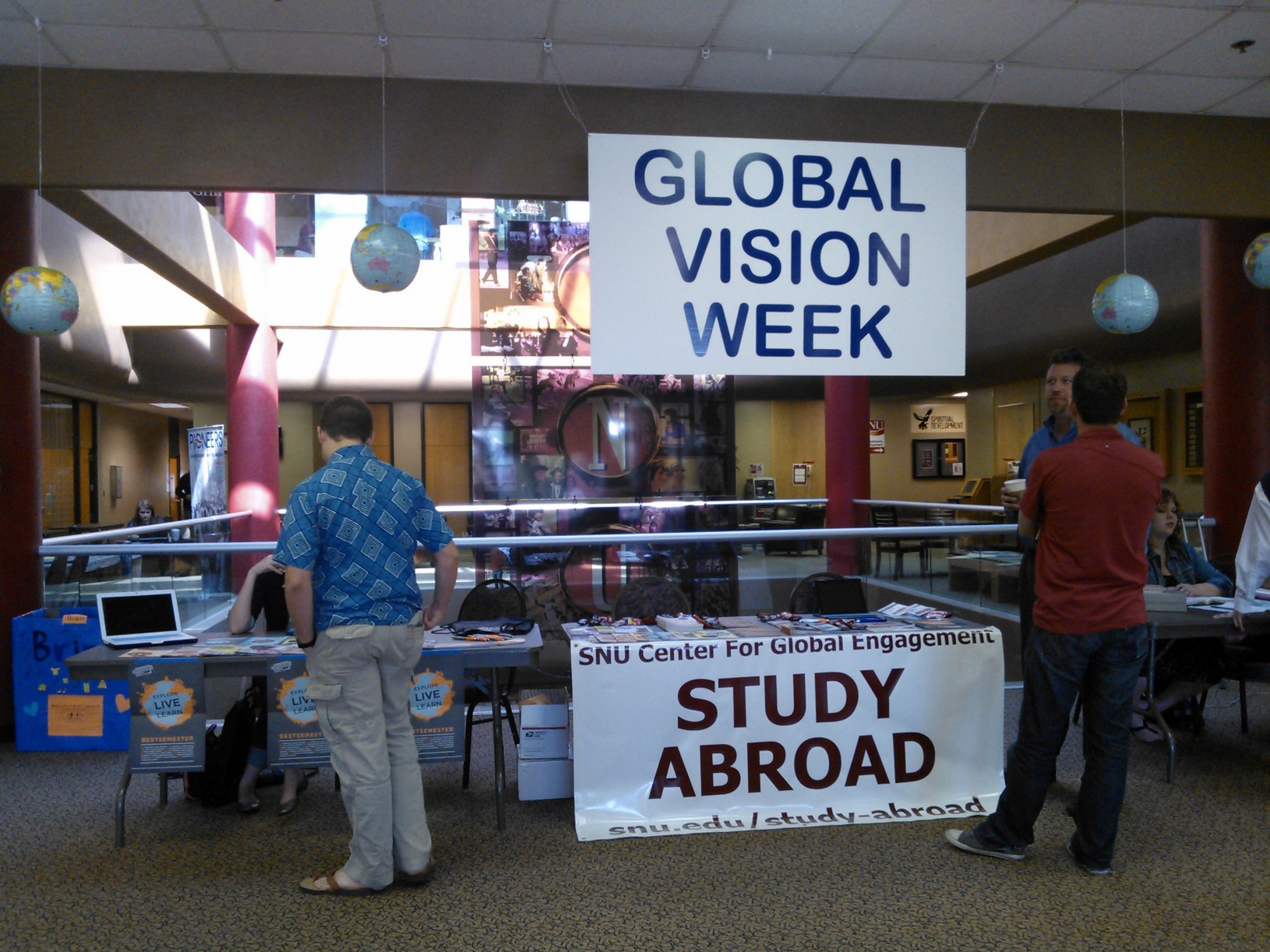
This week is Global Vision Week at the college I am working at and with that came the study abroad fair and international cuisine in the cafeteria. I spent the day meeting students and talking about their dream destinations. Unfortunately the international cuisine was nowhere near as good as the conversation. I would not recommend the college cafeteria as the appropriate place to try ceviche. I’m just hoping it didn’t scare anybody off the idea of studying in Peru!
Let’s just say that this ceviche needed a lot more chips to be enjoyable.
I have to say that working with the children in the refugee community has been quite a learning experience. It’s funny what comes from their mouths and just how innocent they are.
Before I started volunteering, I did my research on Burmese and Iraqi customs. Don’t touch their heads. Don’t point with my feet. Don’t give the thumbs up sign. I was reminded this week that just as I am learning their cultures, these kids are learning ours.
As I was playing with a group of children at the playground this week, an interesting topic came up. The middle finger. All the sudden one of the little girls runs up to me and says, “I can’t use my middle finger, right?” Before I could even answer, several of the little girls are pointing their middle fingers in the air and saying, “You can’t do this, but you can do this.” And then they quickly switch to their pointer finger. From there a whole conversation ensued about why we don’t use the middle finger in America. Thinking back on the conversation, I’m sure it became a topic of our discussion because one of these little ones unknowingly gave “the bird”. I can imagine one of these little girls raising their own middle finger to read a book or scratch their face, and being met with discomfort, discipline, or distraught behavior by their fellow American peers or teachers. If I were in their shoes, I’m sure I would make the same mistakes. If I went to Iraq, could I stop giving a thumbs up? If I was in Myanmar, could I ensure that I never touch a child’s head? I highly doubt I could. I just hope and pray that I can give the patience and guidance to these little ones, just as I would need if I were learning the customs of their home countries.

 I was especially excited for the Hatch Green Chiles in the box because they were perfect for a Mexican-inspired dish that I learned from my Aunt Ethel. Aunt Ethel was my dad’s oldest sister and since she didn’t have any kids of her own, she loved to spoil her nephews and nieces with her amazing cooking. She made the best fried chicken, red velvet cake, and ranger cookies that I’ve ever had. Another one of her great recipes were her enchiladas. With my Hatch Green Chiles, I had everything I needed to make them for dinner last night.








 Global From Home